Last updated on June 4, 2026
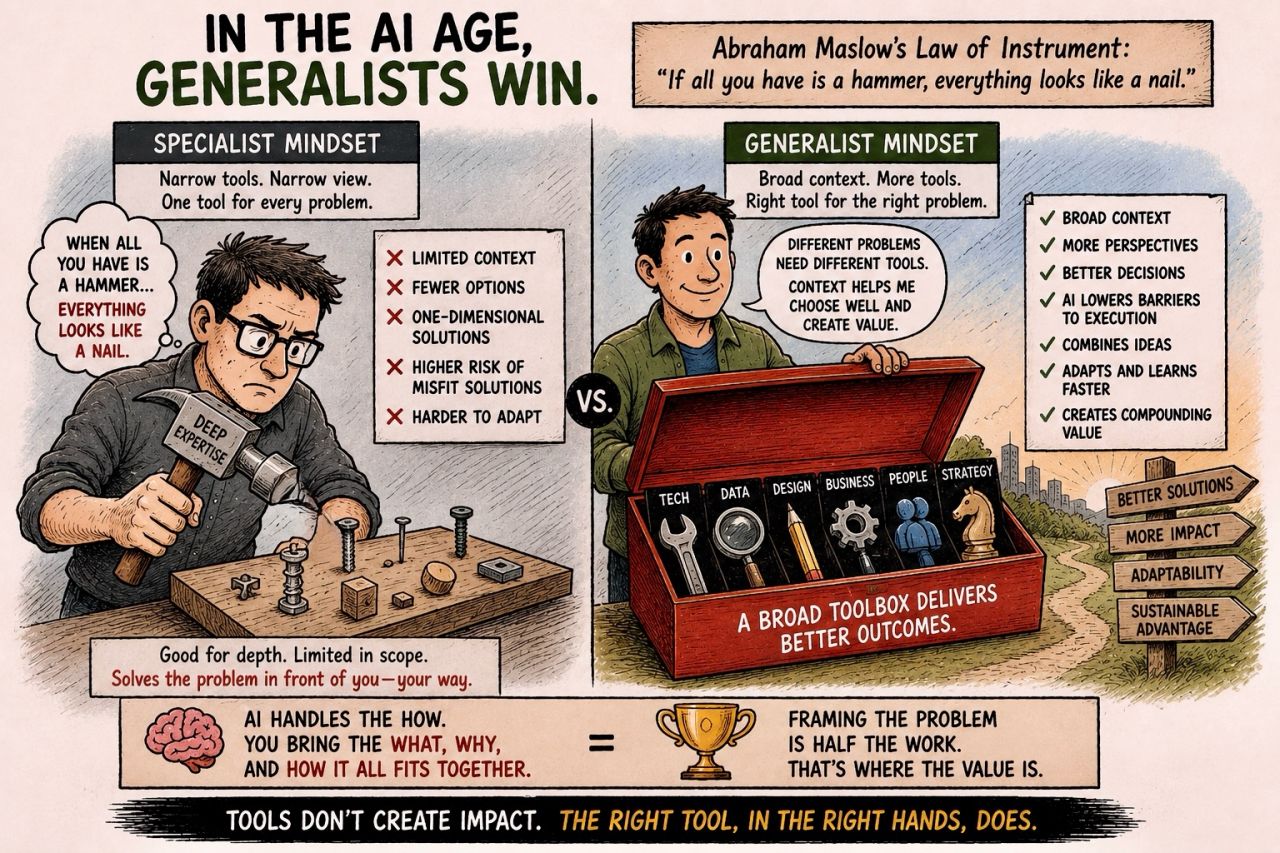
AI is shifting the advantage toward people who know what to do, why it matters, and how it all fits together – not just those who go deepest in a single domain.
For most of the last century, the career playbook was simple: find a field, go deep, become indispensable. Depth was the moat. Specialists commanded premium salaries, held the door on complex decisions, and were the first call when something went wrong. AI hasn’t made expertise irrelevant. But it has quietly restructured where the leverage lives.
“It is tempting, if the only tool you have is a hammer, to treat everything as if it were a nail.”
Abraham Maslow, 1966 – the Law of Instrument
Maslow was describing a cognitive trap. When we master a specific skill, tool, or mindset, we tend to force it onto every problem we encounter – even when it is completely the wrong fit. The specialist with a hammer doesn’t ignore the screw. They misidentify it as a nail.
Having a broader toolbox, I was able to see that the same capability could be moved to a different layer entirely. The problem wasn’t unsolvable. It was being held in the wrong frame. The fix wasn’t cleverness; it was pattern recognition across domains.
The generalist advantage
A toolbox, not a hammer
When you’ve worked across domains, you borrow solutions. The constraint that blocks an expert in one layer becomes the reason to look at a different layer entirely.
Domain A
Systems thinking
See how layers interact; move problems when they can’t be solved where they sit.
Domain B
Product sense
Know what the outcome needs to feel like, not just what the spec says to build.
Domain C
Technical literacy
Enough depth to know when an expert is constrained by their frame, not reality.
Domain D
Pattern recognition
The thing that connects all three above. Earned only through varied experience.
This is where AI enters the picture. AI dramatically lowers the cost of execution for people who already know what to build and why. The analysis that used to take a specialist three days now takes an afternoon. The code that required a senior engineer can be scaffolded in an hour. The research that demanded institutional knowledge can be compressed into a conversation.
For the deep specialist, this is useful but somewhat neutral. It speeds up work they were already capable of. For the generalist, it is transformative. The historical disadvantage of the generalist was execution speed. The knowledge of what to do and how it all connects was there; the bottleneck was time and depth. AI removes that bottleneck. Which leaves the thing AI can’t do: defining the problem correctly. Knowing which layer to operate on. Recognizing that the constraint isn’t real, it’s just local. That is still a human skill – and it is disproportionately the skill of people who have seen many different kinds of problems.
None of this is an argument against specialization. Specialists still matter enormously. The ideal, if there is one, is a generalist with depth: someone who has gone deep in at least one domain, understands what mastery actually feels like, but has also spent time in enough other domains to carry the pattern-matching instinct across fields. What AI reshapes is the return on each type of investment. Deep specialization still earns its keep. But breadth – knowing what to do, why it matters, and how it all fits together – now compounds faster than it used to.
The shift, summarized
- AI lowers the barrier to execution, which raises the value of knowing what to execute on.
- The Law of Instrument explains why specialists miss solutions that exist one layer up (or down).
- The generalist’s historical bottleneck was speed. AI removes it. What remains is the dot-connecting.
- Defining the problem correctly is still a human skill – and it rewards breadth over depth.
- Be a generalist with specialized depth. The goal isn’t shallowness; it’s range.
In an AI-driven world, the people who thrive won’t just be the ones who can solve problems. They’ll be the ones who can see which problem actually needs solving – and why the framing everyone else is using is wrong. That’s not a new skill. It’s just never been more valuable.
